By Royal Limo Services | November 6, 2026 | 13-minute read
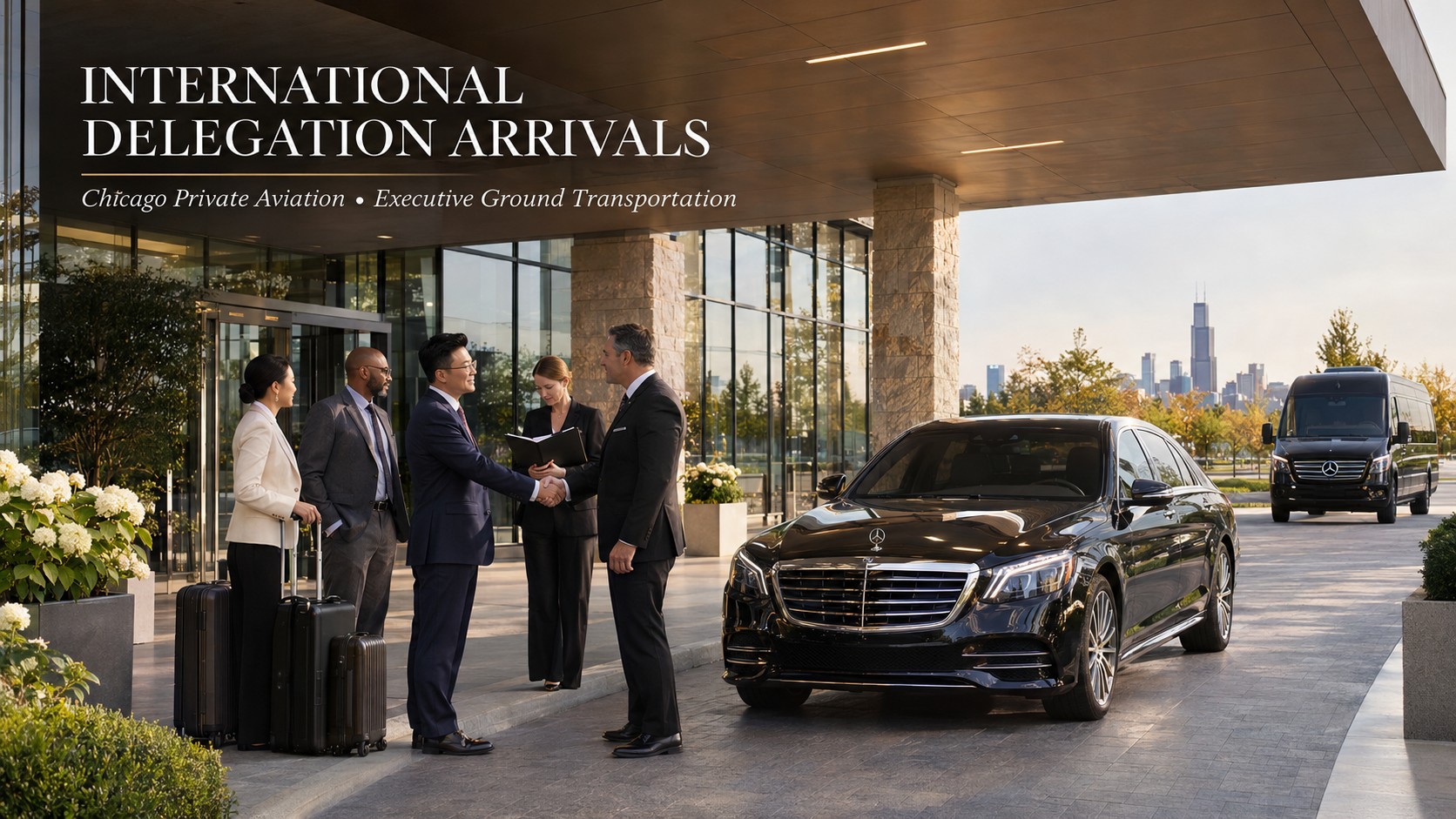
International delegation transportation in Chicago requires careful coordination between the flight department, host organization, FBO, and chauffeur team. When senior executives, diplomatic visitors, business delegations, or international guests arrive in Chicago, the vehicle is only one part of a larger plan involving arrival procedures, protocol, luggage, security considerations, and a demanding schedule.
A delegation may include a principal guest, executive assistants, interpreters, advisers, security personnel, and advance staff. Some passengers may travel to a downtown hotel, while others continue to meetings or separate accommodations. Their transportation must reflect those arrangements without creating unnecessary confusion or attention.
A professional Chicago limo service can coordinate executive sedans, luxury SUVs, Jet Sprinters, and other group vehicles for the ground portion of the visit. The essential task is establishing an accurate, flexible handoff after passengers have completed the required international arrival procedures.
Quick Answer: International delegations arriving by private jet in Chicago should arrange their ground transportation before departure, providing the exact airport and FBO, aircraft details, expected arrival and clearance window, passenger count, luggage requirements, and full itinerary. Chauffeurs meet passengers at an authorized location after required arrival formalities. Vehicle assignments should account for principals, interpreters, staff, security teams, and multi-day schedules.
Coordinating an international delegation’s arrival? Call (866) 811-0999 or arrange a chauffeur reservation with your FBO details, group requirements, and first destination.
Where Ground Transportation Fits Into an International Arrival
An international private aviation arrival has responsibilities that belong to different organizations. The flight department and authorized aviation handler manage aircraft-related arrangements, while U.S. Customs and Border Protection controls the applicable arrival inspection and clearance procedures.
Ground transportation begins once passengers are permitted to depart the relevant inspection or arrival facility and proceed to their authorized pickup location.
Royal’s private airport and FBO limo service supports the onward ground journey. Its chauffeurs do not conduct customs inspections, determine admissibility, or replace an authorized aviation handler.
That distinction matters because international inspection arrangements differ by airport and flight. At some locations, processing may take place in a separate inspection facility rather than the FBO lounge.
The chauffeur plan should therefore use the release and meeting instructions confirmed by the flight handler, not simply the aircraft’s touchdown time.
International Delegation Private Jet Chicago Ground Transportation: Planning the Handoff
The first decision is identifying who has authority to release the transportation team to begin the passenger pickup.
For many delegations, this will be the host’s travel coordinator, a flight department representative, or another designated contact acting after the handler confirms passengers are ready.
Dispatch should receive the aircraft tail number, airport, FBO, estimated arrival, and a reasonable window for completing arrival formalities.
An aircraft landing on schedule does not mean every passenger can immediately enter the waiting vehicle. Inspections, luggage handling, and additional processing may affect the handoff.
The coordinator should establish a clear communication sequence: the flight department provides the arrival update, the authorized contact confirms passenger readiness, and dispatch coordinates the chauffeurs accordingly.
This approach avoids repeatedly moving vehicles or leaving guests searching for transportation at unfamiliar airport facilities.
The Information to Provide Before the Delegation Arrives
A complete transportation request should identify the airport and FBO, aircraft registration, primary host contact, and the group coordinator responsible for the itinerary.
It should also include the total passenger count, the number and approximate size of bags, and any large equipment or presentation cases.
Passenger titles and preferred forms of address may be helpful when protocol requires them. However, only information genuinely needed for transportation should be shared, using appropriate channels.
The booking should specify whether a principal guest requires a separate vehicle, whether interpreters must remain with particular passengers, and whether additional support staff will travel together.
Destination details should be precise. A hotel name without a particular entrance or meeting address may not be sufficient for a large delegation.
Finally, designate a backup contact who can approve transportation changes when the primary coordinator is occupied with arrival procedures.
International Arrival Procedures Are Not the Chauffeur’s Responsibility
International private aircraft arrivals may require advance arrangements, passenger documentation, inspections, and compliance with airport-specific procedures.
Those responsibilities belong to the aircraft operator, flight department, authorized handler, passengers, and relevant government authorities.
Ground transportation coordinators should not assume that every international private jet arrival uses the same customs process or that clearance always takes place in an FBO lounge.
At Chicago-area airports, the location and sequence of inspection can differ. The flight department should confirm current requirements directly with the appropriate authorities and aviation service providers.
Chauffeurs should remain at approved pickup locations and follow the facility’s access rules.
No transportation booking creates an exemption from immigration, customs, or aviation security procedures. Passengers should complete all required formalities before proceeding with the ground itinerary.
Protocol and Courtesy for Distinguished Visitors
Protocol is often expressed through small, practical details rather than elaborate ceremony.
A chauffeur should know the agreed form of greeting, the correct passenger contact, and whether the principal prefers a quiet introduction or a more formal welcome.
Vehicles should be clean, professionally presented, and ready for the confirmed pickup.
When names or titles are supplied for legitimate operational purposes, they should be used respectfully and accurately. The host should also communicate relevant seating preferences before the arrival.
The chauffeur should avoid unsolicited photographs, unnecessary conversation, and discussion of passenger identities or schedules with unrelated people.
A professional executive limousine service provides a suitable transportation framework for visitors who value punctuality, discretion, and orderly coordination.
Good protocol is not about making assumptions based on nationality. The host should communicate each delegation’s actual preferences and requirements.
Discretion and Passenger Information
International delegations may have sensitive schedules, private meetings, and guests whose identities should not be disclosed unnecessarily.
The transportation coordinator should distribute trip details only to the people who need them to perform their assigned roles.
A chauffeur generally needs the meeting instructions, destination, passenger assignment, and relevant service requirements. Extensive personal records or unrelated confidential material are not necessary for an ordinary transportation booking.
Travel coordinators should also avoid sharing passports, immigration documents, or complete security plans through informal communication channels.
If the host requires additional confidentiality procedures, those expectations should be discussed before the reservation is finalized.
Discretion also means avoiding unnecessary announcements at the FBO, displaying guest names publicly without approval, or treating the transportation assignment as a publicity opportunity.
Coordinating With a Delegation’s Security Team
Some international visitors travel with their own security personnel. Transportation and protective services are distinct responsibilities.
A delegation’s authorized security team may identify preferred vehicle positions, meeting locations, approved routes, or additional requirements for the principal.
Royal can coordinate its chauffeur assignments around appropriate instructions agreed upon in advance. The transportation service does not replace the delegation’s security organization or provide armed protection under the arrangement described in this guide.
Any specialized protective service should be contracted and verified separately with the appropriate provider.
For routine executive transportation, the most useful coordination involves accurate vehicle identification, confirmed contacts, approved access points, and timely communication.
Security-sensitive requirements should be shared with dispatch only through authorized channels, and no convoy should assume special traffic privileges or exemptions from road rules.
Choosing the Principal’s Vehicle
A senior guest may travel separately from advisers, staff, and luggage. In that situation, an executive sedan or luxury SUV may be appropriate.
Royal’s Mercedes-Benz S-Class limousine service offers a premium sedan option for smaller parties and individual executives.
A sedan can provide a private cabin for a principal and a small number of accompanying passengers, subject to the confirmed configuration.
The selection should also reflect luggage requirements, entry and exit preferences, and the length of the journey.
Some delegations prefer to keep the principal and adviser together. Others assign the principal to one vehicle while the remaining team follows in a separate SUV or Sprinter.
There is no universal diplomatic seating arrangement that a chauffeur should invent. Follow the host’s documented instructions.
Luxury SUVs for Advisers and Security Personnel
Luxury SUVs can accommodate smaller groups with additional luggage or equipment, depending on the model and seating configuration.
Royal’s luxury black SUV service includes vehicle categories such as the Cadillac Escalade, Chevrolet Suburban, GMC Yukon, and Lincoln Navigator.
An SUV might transport the principal’s advisers, an interpreter, or another designated party within the delegation.
It may also serve as a second vehicle when a principal travels in an executive sedan.
Vehicle capacity should be confirmed using both passenger count and bag requirements. A group carrying presentation cases and several checked suitcases may need more room than a simple seating count suggests.
The host should also indicate whether an accompanying staff member needs to remain seated near a particular guest.
Jet Sprinter Transportation for Five to Eight Guests
Royal’s Chicago Jet Sprinter limo service provides an executive-style option for groups that prefer to travel together.
The Jet Executive Sprinter is described for up to eight passengers, subject to its actual cabin configuration.
For a small international business delegation, this may simplify coordination by keeping executives, interpreters, or advisers in one vehicle.
It can also reduce the number of separate pickup instructions the host must manage.
Nevertheless, an eight-passenger rating does not guarantee sufficient space for eight travelers with extensive luggage and equipment.
A coordinator should provide the full baggage inventory before selecting the vehicle.
If the principal requires a separate sedan, the Jet Sprinter can be considered for other guests, with both vehicles following a mutually agreed schedule.
Executive Sprinter Vans for Larger Delegations
For a group of approximately nine to fourteen passengers, an executive Sprinter may be appropriate depending on the vehicle’s configuration.
Royal’s Mercedes Sprinter van rental service provides a group transportation option for business and event travel.
These vehicles can help move interpreters, administrative personnel, advisers, and other guests who share a destination.
The coordinator should confirm usable seating capacity, baggage space, and access conditions at the FBO and hotel.
If the number of passengers exceeds the suitable capacity of one vehicle, multiple vehicles may be necessary.
Group transportation should never depend on adding passengers beyond the approved seating arrangement or placing luggage where it compromises safe travel.
Organizing Multiple Vehicles Without Confusion
Larger delegations often need a coordinated group of vehicles rather than one oversized vehicle.
A practical arrangement might place the principal and adviser in an S-Class, several guests in a Jet Sprinter, and additional staff in a conventional Sprinter.
Each chauffeur should receive the correct passenger assignment, destination, and designated coordinator.
Vehicles may depart together where road and airport conditions permit, but they must obey ordinary traffic laws and cannot assume priority movement through intersections.
The transportation plan should identify what happens if one group is delayed during arrival procedures.
It should also specify who communicates changes to the hotel or event host.
The objective is coordinated arrival, not an unauthorized motorcade or a promise that all vehicles will remain together under every traffic condition.
Interpreters, Advance Staff, and Late Passenger Changes
Staffing changes are common during major international visits. An interpreter may be added late, an adviser may join from another flight, or an additional support person may accompany the principal.
These changes can affect both seating and luggage space.
A transportation coordinator should confirm the final headcount before the travel date and communicate changes promptly.
If interpretation is needed during the journey, the assigned interpreter should travel in the vehicle where their assistance is required.
Advance staff may need to reach the hotel or venue before the principal. That could require a separate vehicle or a different departure time.
The host should communicate these distinctions rather than assume every member of the delegation will travel together.
Managing Luggage, Documents, and Equipment
Delegation luggage may include personal bags, business materials, presentation equipment, gifts, and other authorized items.
These needs should be evaluated before the vehicles are assigned.
A small delegation with numerous checked bags may require more cargo capacity than a larger group traveling with minimal baggage.
The host should identify oversized cases and special handling requirements without unnecessarily disclosing confidential contents.
Passengers remain responsible for complying with applicable customs, security, and transport rules. Chauffeurs do not inspect sealed items or determine whether goods may enter the United States.
If equipment requires special loading arrangements, discuss them with dispatch and the relevant airport or property operator in advance.
An accurate baggage count is often as important as the passenger count.
Multi-Day Visits and Consistent Chauffeur Assignments
International delegations often remain in Chicago for several days, with meetings, receptions, tours, and additional business appointments.
For a complex visit, using consistent vehicle assignments can reduce confusion.
Royal’s roadshow and executive itinerary transportation provides a useful model for multi-stop business travel.
A host may request the same chauffeurs and vehicles throughout the visit, subject to availability, working schedules, and confirmed reservations.
The daily itinerary should establish pickup times, locations, expected waiting periods, and the person authorized to approve changes.
If appointments run late, the host should notify dispatch rather than assume the chauffeur assignment automatically extends without limits.
Continuity is valuable, but reliable service depends on clear scheduling and realistic driver availability.
Hourly Service for Flexible Delegation Schedules
An international delegation may need transportation for a full day rather than a simple transfer between two addresses.
Royal’s hourly limo service is relevant when the itinerary includes several meetings, waiting periods, and changing destinations.
The supplied private aviation pricing brief describes hourly bookings with a three-hour minimum and point-to-point reservations quoted individually.
It also specifies a 20% gratuity added to the hourly total, with taxes and tolls included under those stated terms.
Customers should confirm the exact arrangements in their written quote because pricing conditions can vary by service and reservation.
For multi-day bookings, ask dispatch how additional hours, schedule extensions, vehicle changes, and cancellations will be handled.
A detailed agreement avoids uncertainty when the itinerary changes.
Corporate Meetings and Executive Roadshows
Many international delegations visit Chicago to meet business partners, investors, manufacturers, or professional organizations.
An arrival at an FBO may be followed by appointments in downtown Chicago, Rosemont, Oak Brook, or other business districts.
Royal’s corporate limo service supports business-focused ground transportation across the metropolitan area.
The host should provide exact building entrances and meeting times rather than rely on a broad neighborhood destination.
For office buildings with controlled access, confirm visitor instructions and any restrictions on vehicle pickup.
If several delegates are attending different appointments, the transportation plan may require separate vehicles or staggered schedules.
The final itinerary should distinguish between essential appointments and optional stops so that changes can be handled sensibly.
Convention and Conference Delegation Transportation
Major conventions can bring international business groups to Chicago for exhibitions, conferences, and organized industry meetings.
Royal’s convention transportation service is relevant when groups need coordinated transfers between hotels, meeting venues, and exhibition facilities.
Large events may have designated pickup locations and vehicle restrictions. These arrangements should be checked before the delegation arrives.
The host should also consider whether the group will leave together or split into separate meetings.
During busy convention periods, confirming the number of vehicles and the daily itinerary well ahead of time is particularly valuable.
A group pickup plan should include a realistic assembly period, especially when attendees depart from different rooms or meeting areas.
Hotels, Receptions, and Venue Access
A hotel’s public entrance is not always the best place to stage several luxury vehicles.
For downtown properties, loading areas may be limited, especially during conferences, evening receptions, and major events.
Royal’s downtown Chicago hotel car service guide provides context for hotel pickups and arrivals.
For delegations staying outside central Chicago, private hotel transfers across Illinois may also be relevant.
The host should contact the hotel or event venue to confirm permitted vehicle access, staging instructions, and any special entrance arrangements.
Where a guest requires a private arrival, the venue must authorize the appropriate entrance.
Transportation coordination cannot override a hotel’s security or access procedures.
Delegations With Itineraries Beyond Chicago
Some international visits include stops in New York, Canada, or other cities before or after the Chicago portion of the itinerary.
Royal describes an affiliate arrangement for New York transportation and a separate Canada-to-Chicago affiliate service.
These pages may be useful when an organizer is considering a broader travel program.
However, a Chicago chauffeur reservation should not be assumed to include transportation in another market.
Any affiliate service, local provider, vehicle category, and operational terms must be confirmed separately.
For international travel, the flight department and passengers remain responsible for the relevant aviation and border-entry arrangements.
A Sample International Delegation Arrival Plan
Consider a hypothetical delegation of twelve guests arriving by private jet for two days of business meetings in Chicago.
The group includes one principal, an adviser, two interpreters, and several additional representatives.
A week before arrival, the host identifies the FBO, total headcount, luggage, hotel, meeting destinations, and preferred passenger assignments.
An S-Class is requested for the principal and adviser, while the remaining travelers are assigned to suitable group vehicles after dispatch confirms capacity.
The flight department provides the aircraft details and a contact responsible for the international arrival process.
On arrival day, the handler communicates the group’s readiness after required formalities. Dispatch then coordinates pickup at the approved location.
The principal travels to the hotel, while advance staff continue to the next venue according to the confirmed itinerary.
The following day, the host updates dispatch as meetings conclude.
This example shows how transportation responsibilities can be divided without assuming that every delegation requires the same arrangement.
Changes, Delays, and Contingency Planning
International arrival schedules can change because of aircraft operations, passenger processing, weather, or other circumstances.
The host should establish who will notify dispatch when a flight is delayed, the arrival location changes, or passengers are not ready at the originally expected time.
If the aircraft diverts, the booking may need a different vehicle assignment or pickup schedule.
A late-running inspection does not mean the chauffeur can bypass the approved meeting procedure.
For multi-vehicle arrangements, the host should confirm whether all passengers will wait together or whether cleared groups may depart separately when permitted and appropriate.
The best contingency plan is simple: a designated decision-maker, a backup contact, accurate updates, and clear instructions for passengers and chauffeurs.
A Final Booking Checklist for Protocol Officers
Before confirming the transportation reservation, make sure the basic details are settled.
- Identify the correct airport, FBO, and authorized pickup location.
- Confirm the tail number, arrival estimate, and contact responsible for passenger readiness.
- Provide the passenger count, vehicle assignments, interpreters, and baggage requirements.
- Communicate relevant greetings, seating preferences, and accessibility needs.
- Establish the principal’s itinerary separately from other staff when necessary.
- Confirm hotel and venue entrances, daily pickup times, and return transportation.
- Review waiting-time arrangements, written pricing, and procedures for schedule changes.
- Provide a primary host contact and a backup authorized to make decisions.
The checklist should support the delegation’s wider travel plan without collecting unnecessary confidential passenger information.
Frequently Asked Questions
Can Royal provide transportation for international delegations arriving by private jet?
Yes. Royal offers FBO ground transportation, executive sedans, SUVs, and Sprinter options. The vehicle arrangement depends on passenger count, luggage, itinerary, and availability.
Does Royal handle customs or immigration clearance?
No. Government authorities and the authorized aviation parties manage the relevant arrival procedures. Chauffeured transportation begins when passengers are permitted to proceed to the approved pickup location.
What details should a delegation coordinator provide?
The airport, FBO, aircraft information, expected arrival and clearance window, headcount, luggage requirements, destination addresses, and authorized contacts are essential.
Can a large delegation use multiple chauffeured vehicles?
Yes, subject to confirmed availability. Vehicle assignments can be coordinated for principals, advisers, interpreters, and other staff, with each driver following the agreed itinerary.
Can Royal work with the delegation’s security personnel?
Royal can coordinate ground transportation details with an authorized security team. This is not a substitute for specialized protective services or armed security.
Can the same chauffeurs serve a delegation for several days?
Consistent chauffeur and vehicle assignments can be requested for a multi-day itinerary. They must be confirmed according to availability, scheduling, and reservation terms.
What happens if the private jet arrives late?
The flight department or host should provide the revised arrival details. Dispatch can then review the meeting arrangements and confirm any necessary changes to vehicle timing.
Reserve Ground Transportation for Your International Delegation
Successful delegation transportation depends on a well-organized handoff, suitable vehicles, respectful protocol, and clear communication throughout the visit.
Whether the itinerary involves one principal or several coordinated vehicles, provide the full travel schedule and passenger requirements when requesting service.
For a personalized international delegation transportation plan, request a quote or call (866) 811-0999.
Royal Limo Services — Contact Information
Address: 5600 N River Rd, Suite 800, Rosemont, IL 60018
Phone: (866) 811-0999